We Want Your
Silver Plated Items!
Faulcon Enterprises, in partnership with SAHD Metal Recycling,
is actively collecting silver plate — and paying for it.
Drop off your silver plate items at SAHD Metal Recycling in Columbia, PA. No appointment needed for smaller lots — just bring it in and get paid on the spot.
📌 SAHD Metal Recycling accepts silver plate items only. Weighted sterling and solid sterling silver are not handled at this location — see our Weighted Sterling program.
What Is Silver Plate?
Silver plate is an item made from a base metal — most commonly copper, brass, or steel — that has been coated with a thin layer of real silver through a process called electroplating. Silver plate became widely popular in the mid-1800s as a more affordable alternative to solid silver. Brands like Rogers Brothers, Reed & Barton, Oneida, and WMF produced enormous quantities through the late 1800s and well into the 1900s.
Because it contains real silver — even if only a very thin layer — silver plate has genuine recycling value when collected in sufficient quantity. That silver can be chemically stripped and recovered for reuse.
✓ Silver Plate IS…
- •A base metal with a real silver coating
- •Made by electroplating or Sheffield fusion
- •Marked EP, A1, EPBM, or similar
- •Tarnishes to yellowish-brown or dark gray
- •May show base metal at wear points
✗ Silver Plate is NOT…
- •Sterling silver (solid .925)
- •Weighted or reinforced sterling
- •Stainless steel (18/8 or 18/10)
- •Chrome-plated metal
- •Pewter (tin-based, no silver)
- •Nickel silver / German silver
Have weighted or reinforced sterling? That's a separate program. SAHD Metal Recycling does not accept it here, but Faulcon Enterprises will purchase it directly at $15/lb — see the Weighted Sterling page.
How to Identify Silver Plate
The most reliable method: look for hallmarks — small stamps on the back, underside, or handle of the item.
Electroplated — silver was deposited onto a base metal
Highest weight of silver plate applied; common on quality flatware
Electroplated Britannia Metal — silver over a tin-antimony alloy
Electroplated White Metal — silver over a white metal alloy
Pre-1840 method of fusing silver sheet to copper by heat
German manufacturer; most WMF pieces are silver plated
American brands known for silver plate since the 1800s
Oneida's Community brand and International Silver — both silver plate
Wear Through
Base metal (copper/brass) shows at edges of forks and rims of trays — a reliable sign.
Tarnish
Silver plate tarnishes to yellowish-brown. Stainless and chrome do not tarnish.
Weight
Heavier than aluminum. Unusually light items are likely not silver plate.
Seams on Hollowware
A visible construction seam on pitchers, teapots, and candlesticks is normal and expected.
Not sure? Bring it in. SAHD Metal Recycling staff will assess each item at no charge. You do not need to be certain before coming in.
Photo Guide: Reading the Marks
Real photographs of the stamps you will find — and what each means for your item.
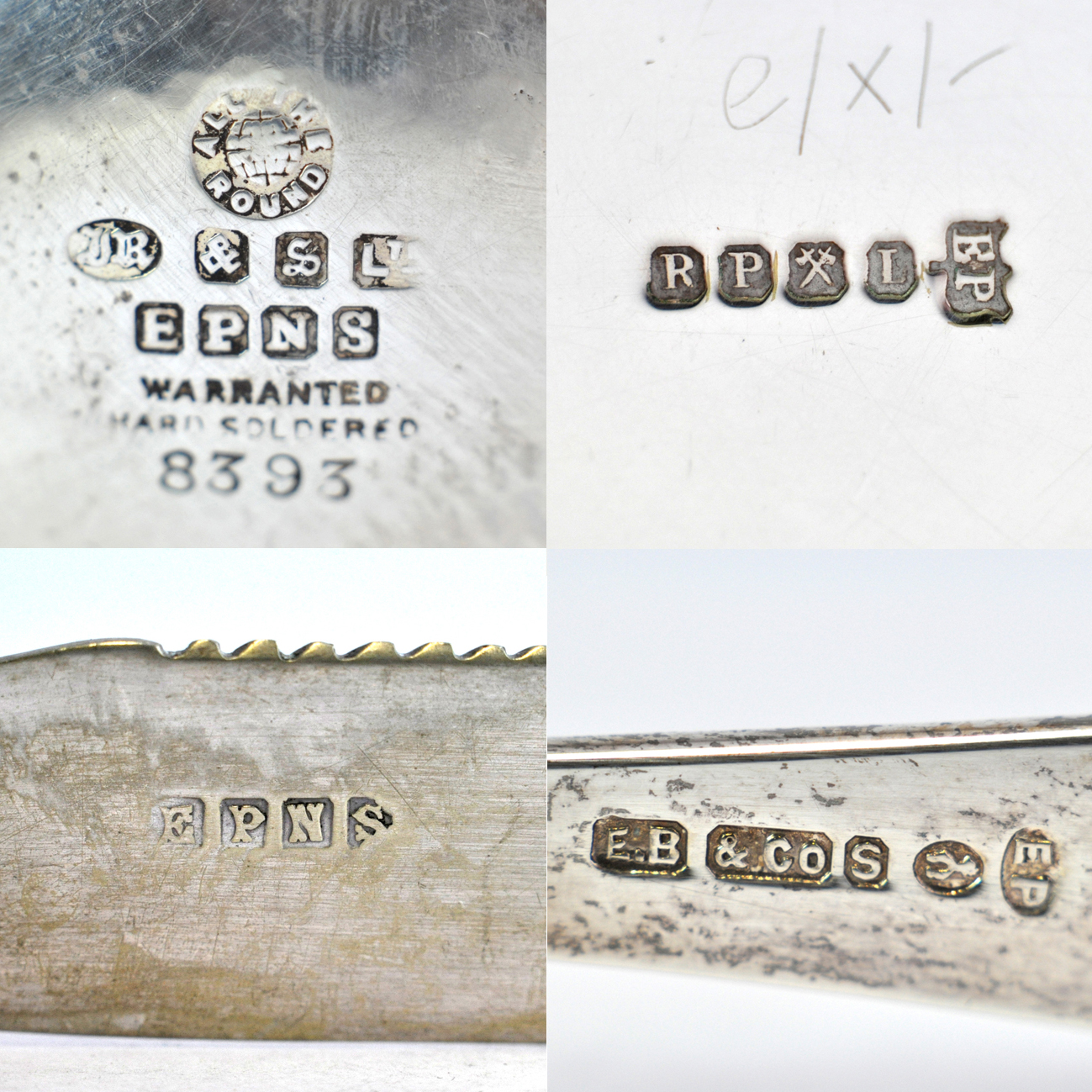
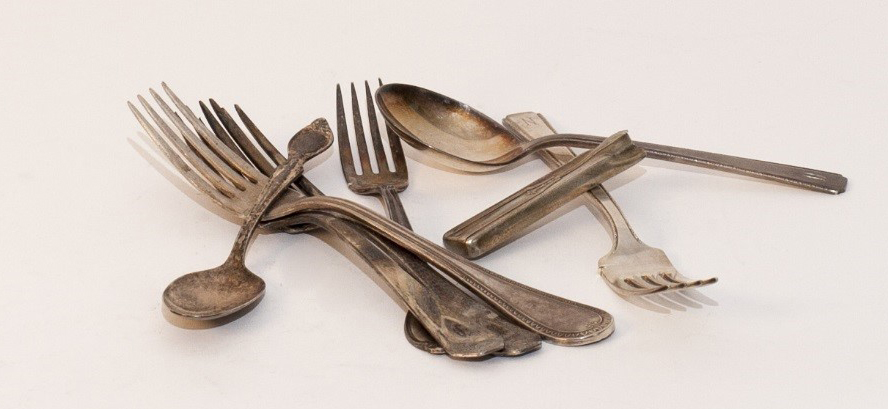

Tip: Turn the piece upside down and check the spine of a fork handle or underside of a tray near the rim. Marks are small — a magnifying glass helps. On hollowware, check the foot rim.
Why Volume Matters
The silver coating on most electroplated items is measured in microns — a typical fork has between 10 and 40 microns of silver. That's a fraction of a gram per piece — worth cents to a dollar or two individually. Not enough to justify the cost of stripping and refining on its own.
But collect hundreds of pounds and the silver adds up to real, recoverable ounces. Think of it like aluminum cans — one can is worth almost nothing, but a truckload is worth real money. Silver plate works the same way. That's why this program works: your single box contributes to a larger volume that makes recovery viable for everyone.
Bring everything
Worn, tarnished, partial sets — every pound counts.
You get paid
A fair per-pound rate on the spot, regardless of piece count.
Zero waste
After silver recovery, the base metal is recycled separately.
Spread the word
Know someone with a box of old flatware? Send them our way.
Accepted Items
The following silver plate items are accepted at SAHD Metal Recycling. All items assessed by staff before acceptance.
Items must be predominantly metal. Payment is based on total weight — if an item is mostly glass, ceramic, wood, or other non-metal material, the silver plate portion is too small to justify acceptance. All-metal items only.
💬 Sound familiar?
Couldn't sell that silver plate bowl at the yard sale? Bring it to us — we'll put a few dollars in your pocket instead.
Grandma's old tea set collecting dust in the basement? It's worth more to us than it is to the cobwebs.
That box of tarnished flatware from the estate sale that nobody wanted? We want it.
No takers on the serving tray? We're your buyer — no haggling, just a scale.
Flatware & Cutlery
Forks and spoons only — full sets or partial. Knives are not accepted.
Serving Trays & Platters
Oval, round, or rectangular trays of any size
Tea & Coffee Services
Teapots, coffee pots, creamers, sugar bowls — sets or individual pieces
Pitchers & Gravy Boats
Water pitchers, sauce boats, and similar pourers
Candlesticks & Candelabras
Silver plate only — not weighted sterling (see separate program)
Bowls & Compotes
Serving bowls, fruit bowls, footed compotes
Napkin Rings
Plain or ornate, any style
Bread Baskets & Butter Dishes
Woven-wire baskets and covered butter servers
Salt & Pepper Sets
Salt cellars and shakers with silver plate bodies
Toast Racks
Classic English-style silver plate toast holders
Misc. Hollowware
Soup tureens, ice buckets, wine coolers, and similar all-metal serving pieces
Other silver plate tableware may be accepted at staff discretion.
Items SAHD Does Not Accept
These categories are commonly confused with silver plate but do not qualify at this location.
✗ Sterling Silver (Solid)
Solid sterling (.925) is a precious metal worth significantly more than silver plate. SAHD does not handle it.
How to Spot It
Marked .925, 'Sterling,' or 'Ster.' No base metal wear-through.
✗ Weighted or Reinforced Sterling
Genuine sterling filled with pitch or plaster. SAHD does not accept these — see the Faulcon Enterprises Weighted Sterling program.
How to Spot It
Marked 'Sterling Weighted' or 'Reinforced Sterling.' Feels very heavy. Felt pad on base.
✗ Silver-Plated Knives
The blade is typically stainless steel and the handle is usually hollow and filled — recoverable silver is minimal. Bring forks and spoons only.
How to Spot It
Part of flatware sets — set knives aside and bring only forks and spoons.
✗ Nickel Silver (Unplated)
Nickel silver — also called German silver, alpaca, or argentan — contains absolutely no silver despite the name. It is a copper-zinc-nickel alloy. Only qualifies if it has a confirmed silver plate coating on top.
How to Spot It
Marked 'NS,' 'German Silver,' 'Nickel Silver,' or 'Alpaca.' Resists tarnish. No EP, A1, or plating mark present.
✗ Stainless Steel
No silver content whatsoever.
How to Spot It
Marked '18/8,' '18/10,' or 'Stainless.' Does not tarnish.
✗ Chrome-Plated Items
Chrome plating uses no silver — no recoverable silver content.
How to Spot It
Harder, shinier finish. No tarnish. No silver hallmarks.
✗ Pewter
Tin-based alloy with no silver content.
How to Spot It
Marked 'Pewter.' Soft, matte finish. Bends easily.
✗ Flatware with Non-Metal Handles
Only all-metal flatware qualifies.
How to Spot It
Check handles — solid metal throughout the full length is fine.
Frequently Asked Questions
Ask a Question
Not sure if your item qualifies? Ask us — we'll help before you make the trip to SAHD.
Have weighted or reinforced sterling to sell?
See Weighted Sterling Program →